When a young brand scales quickly, branded search demand often emerges before the business is ready for it. Some users stop clicking ads and start searching for the brand directly on Google, typically with queries like “brand login” or “brand registration.” If the brand has not built its SEO presence early on, affiliates and competitors move in fast and take over the branded SERP. As a result, the business ends up paying for its own demand – buying back branded traffic through affiliate deals instead of capturing it through its own assets.
At that point, there is a choice. A company can keep treating branded demand like regular acquisition and continue paying market rates for users who were already looking for the brand. Or it can build a search strategy designed to secure the branded SERP, reclaim high-intent branded queries, and route users to controlled entry points.
This is exactly the situation we faced in one of our cases with BoostWin, a fast-growing iGaming brand in a CIS market. Below, we unpack this case and also explain what branded traffic really is, why even strong teams lose control of it, and how a business can end up paying twice for its own demand.
Branded Traffic and Why Even Experienced Operators Get It Wrong
But before we get to the case itself, let’s take a look at the branded-traffic problem. As noted above, this traffic comes from users searching for the brand name usually together with an action query such as login, registration, and so on. Unlike cold demand, these users are already warmed up: they have heard of the product, remembered the name, and are searching for it specifically.
In other words, branded demand has already been paid for. So when you lose it in search, you are often losing efficiency across the entire funnel.
In practice, branded demand often grows faster than the infrastructure for SERP control can be put in place. The key mistake even large businesses make is failing to support – or never building in the first place – their own brand SEO setup. As a result, companies turn their branded SERP into so-called “shared territory”: third-party sites, affiliate pages, and competitors start appearing alongside the official entry point, and a significant number of clicks stop going to the product.
Put simply, it looks like this: the brand invests in awareness, while someone else captures the return.
Why Does This Happen?
There are several common reasons, and almost all of them come down to the same thing: it feels easier to buy branded demand here and now than to build a system for controlling the branded SERP.
- Solving the problem quickly through partner models: RevShare/CPA. At the start, this looks logical: affiliates help a brand scale while demand has not yet formed. But once awareness grows and branded search appears, the brand starts paying RevShare/CPA for users who are already searching for it directly – in other words, it is effectively buying back its own demand.
- Cross-routing users to another offer or brand – and fear of losing control over the user journey. If the branded SERP is not secured, some clicks go to third-party pages in the search results – affiliates or competitors. The business then compensates in the fastest possible way: it buys branded actions through external models instead of fixing the root cause by reclaiming and retaining branded clicks on the official entry point.
- Pricing mistake: branded demand is treated as standard acquisition. In practice, branded actions are often valued at standard market acquisition rates (in our experience, around $30 per action), even though this traffic is already warmed up. In this case, for example, eCPA (effective cost per acquisition) from SEO was $60 before we stepped in, but after we implemented the strategy, it dropped dramatically to $6.
- Organizational/technical reason: SEO gets postponed because the product is not ready. When implementation requires developer involvement – scripts, indexation, content blocks – brand SEO is often pushed to the backlog. Once again, the short-term horizon wins: it seems easier to buy traffic now than to build systematic SERP control.
Case Study: How We Built a SERP Control Strategy for BoostWin
Now to the practical side. When we started working with the brand, it was still relying on other acquisition channels, but branded demand was already emerging: users remembered the name and were increasingly searching for it directly. Branded demand formed quickly, but the brand SERP had not yet been built out or protected. As a result, competitors and affiliates quickly occupied top positions, and the brand found itself forced to pay for its own branded traffic twice.
On top of that, Google did not always recognize the brand as a distinct entity, so competitors with similar-sounding names often appeared in the branded results.
Our main objective was to dominate the SERP and win back branded demand. We also needed to establish the brand as a standalone entity and separate it from similar names.
Launch Timeline
Project kick-off and tracking launch: May 12-18, 2025.
Preparatory work started ahead of the official project launch, with the infrastructure going live a month before tracking began. During the pre-launch phase, the team also provided trademark (TM) consulting to strengthen the brand and reduce the risk of search-demand hijacking in Google.
Spend
Total spend from May 2025 through January 2026 came to $128,534.15. Monthly breakdown:
| Month | Spend, $ | eCPA, $ |
| May 2025 | 5,455 | – |
| June 2025 | 17,397 | 2.900 |
| July 2025 | 20 774 | 60 |
| August 2025 | 18 834 | 23 |
| September 2025 | 21 546 | 26 |
| October 2025 | 18 990 | 21 |
| November 2025 | 6 530 | 8 |
| December 2025 | 9 479 | 7 |
| January 2026 | 9 527 | 6 |
Step 1. Product-First Approach
If the official resource is not indexed and not secured, there is nothing to strengthen. Based on this approach, we launched the main product site first and got it indexed before rolling out the satellite network – the supporting sites built around it.
In other words, first you create an owned entry point (the official site), and then you build the retention infrastructure around it.
Step 2. A Network of Branded Assets for Systematic SERP Coverage
Next, we built a network of branded SEO support sites:
- We started with 40 sites (20 for Google and 20 for another regional search engine)
- We then expanded the network as branded demand grew
- And we ultimately scaled it to 109 satellite sites
Step 3. Domain Resilience: The EMD Strategy
To keep the network manageable and scalable, we based the strategy on exact-match domains (EMDs), meaning domains that contain the target keyword or brand. We also built a domain pool:
- We acquired around 200 quality EMDs
- We created a reserve of 300+ EMDs to scale into other markets and quickly replace assets
We also built a custom SEO Layer – an independent SEO environment that lets us implement technical changes, scale content, and manage indexation freely. Without this solution, even standard SEO implementation tasks could take up to a month, largely due to dependency on the product team. The solution removed that bottleneck, allowing changes to go live much faster.
Important point: SERP control means building infrastructure with a certain margin of safety. Getting just one site to the top is not enough to make it work.
Step 4. Link Profile: Strong and Natural
Next came the ongoing work required to hold the network’s positions in search:
- We expanded our pool of forum and community placements – natural references to the product site in comments, reviews, and discussion threads
- We secured manual links and mention placements on relevant platforms
- We also diversified sources so the profile remained balanced and natural
Technically, you can deploy a network quickly, but SERP stability comes from ongoing ops, which is a systematic, repeatable work.
Step 5. Expired-Domain Strategy and 301 Redirects: Retention and Replacements Without Losses
On an ongoing basis, we:
- Found dropped domains – expired domains that became available again and were repurchased
- Set up 301 redirects (redirecting users and search crawlers from outdated links to new ones without losing the authority of the old URL) to preserve the branded SERP and keep the asset structure stable.
Step 6. Daily Competitor Monitoring and Retaining Control Share
As the brand grows in search, competitors targeting branded queries start appearing on a regular basis. So we built a process of daily monitoring and predefined response steps to minimize branded-traffic hijacking and maintain control over the SERP.
Parallel Track: Work on the Product Site
Alongside the rollout of the brand SEO infrastructure, we also strengthened the BoostWin’s product site.
In iGaming projects, platforms are often overloaded with scripts and not SEO-ready out of the box, so we started with a detailed technical audit, proposed a development strategy, and launched the foundational SEO work.
On the product site, we added content to key category pages, completed localization (translations), and ran an additional content-quality review. We also worked separately on the indexation of product sections and game pages so that key pages would be properly picked up by search. This was supported by a multi-layered link strategy.
We also built semantic keyword sets for local language variants, clustered queries by intent, defined landing pages and priorities, and – because competition in broad high-volume clusters was so intense – focused on mid-competition clusters and evaluated Google’s response.
Reporting Process: Traffic and Quality
To measure the impact in commercial terms – in other words, in money terms – rather than just tracking rankings, we monitored:
- Click2Reg (click-to-registration conversion)
- Reg2Dep (registration-to-deposit conversion)
- FD (number of first deposits)
| Month | Click2Reg | Reg2Dep | FD |
| May 2025 | 1% | 0% | 0 |
| June 2025 | 4% | 21% | 6 |
| July 2025 | 22% | 57% | 345 |
| August 2025 | 20% | 53% | 835 |
| September 2025 | 21% | 66% | 818 |
| October 2025 | 36% | 49% | 910 |
| November 2025 | 13% | 54% | 798 |
| December 2025 | 12% | 48% | 1 340 |
| January 2026 | 9% | 49% | 1 560 |
We also used our own AI tool as an internal monitoring layer. It regularly collected branded-cluster SERP data (groups of branded queries and variations), automatically classified results, and sent alerts when the share of controlled positions changed. That allowed one specialist to oversee 100+ sites and respond to SERP changes faster.
When fluctuations occurred, we followed a playbook:
- We checked referral links to make sure traffic was attributed correctly and sent users to the right entry points;
- We rechecked the competitive branded SERP to see if any new domains had entered the top results and how the click split had changed;
- We regularly checked the satellite sites for indexation, availability, and key-page health so we could quickly address any drops.
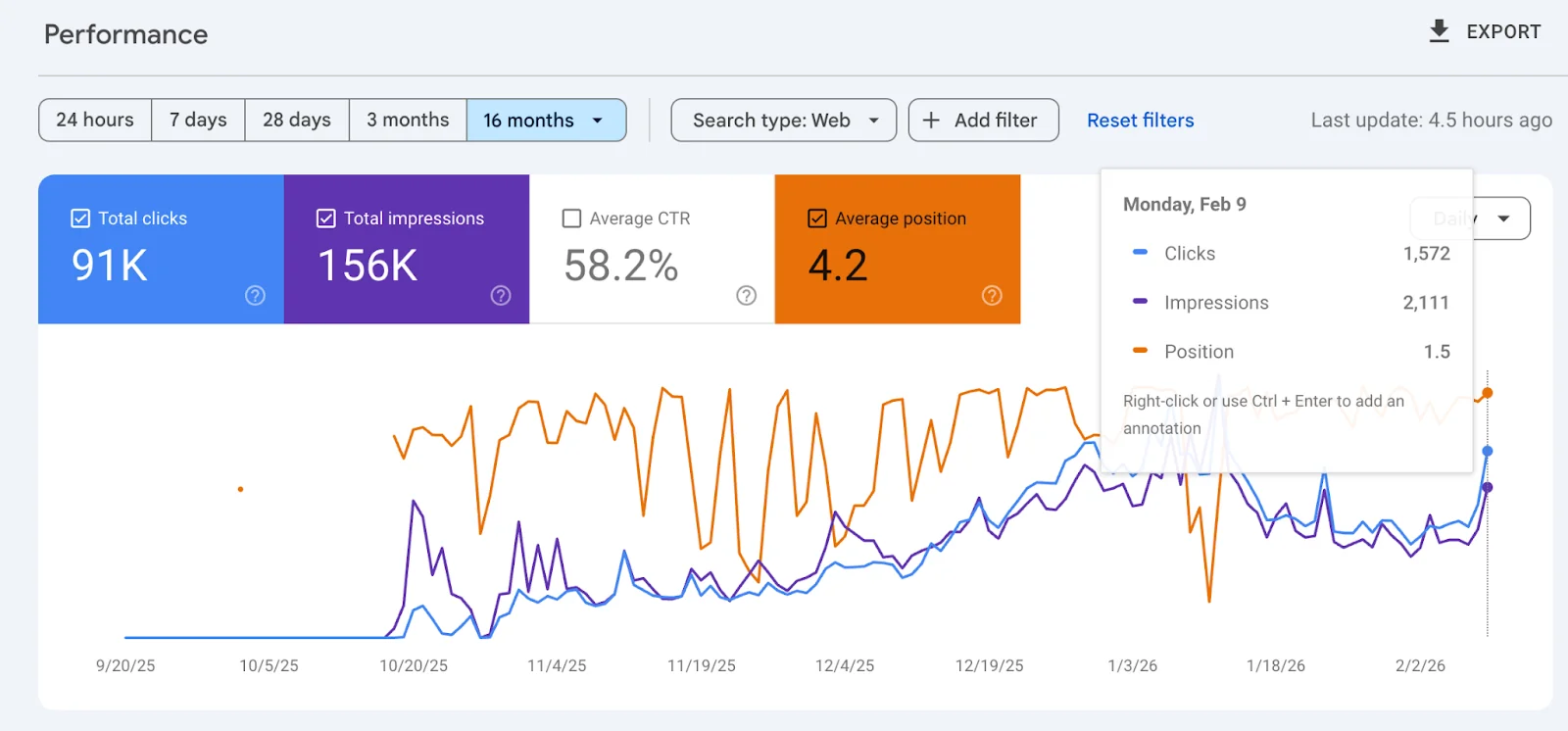
Below is an example from Google Search Console for one of our top-performing satellite sites:
Results and Statistics
Core KPI Dynamics, July 2025 – January 2026
This period clearly shows how scaling the network turned it into a stable channel:
- Clicks: 6,564 -> 78,730 (12x growth)
- Unique users: 2,784 -> 35,637 (12.8x growth)
- Registrations: 605 -> 3,187 (5.3x growth)
- FD: 345 -> 1,560 (4.5x growth)
- eCPA: $60 -> $6 (cost down 90%)
- Domains displaced from the branded SERP: 147
| Metric/Month | January | December | November | October | September | August | July |
| Clicks | 78 730 | 54 624 | 21 852 | 11 588 | 11 674 | 17 131 | 6 564 |
| Unique users | 35 637 | 22 759 | 11 304 | 5 165 | 5 842 | 8 033 | 2 784 |
| eCPA | $6 | $7 | $8 | $21 | $26 | $23 | $60 |
Monthly Dynamics
| Month | Clicks | Unique users | Registrations | FD | Spend, $ | eCPA |
| July 2025 | 6 564 | 2 784 | 605 | 345 | 20 774 | 60.21 |
| August 2025 | 17 131 | 8 033 | 1 584 | 835 | 18 834 | 22.56 |
| September 2025 | 11 674 | 5 842 | 1 232 | 818 | 21 546 | 26.34 |
| October 2025 | 11 588 | 5 165 | 1 860 | 910 | 18 990 | 20.87 |
| November 2025 | 21 852 | 11 304 | 1 474 | 798 | 6 530 | 8.18 |
| December 2025 | 54 624 | 22 759 | 2 799 | 1 340 | 9 479 | 7.07 |
| January 2026 | 78 730 | 35 637 | 3 187 | 1 560 | 9 527 | 6.11 |
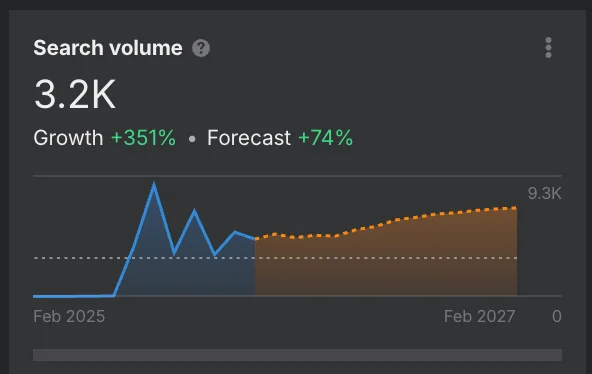
Ahrefs Branded Demand Growth
Over the course of the engagement, Ahrefs showed branded keyword search volume growing from 0 to 3,200 – and it continues to rise.
Brand SEO’s Share of Acquisition
We also tracked the impact not only at the SEO channel level, but across the overall acquisition mix:
SEO’s share of total acquisition grew from 0.83% (May 2025) to 27.86% (January 2026).
The monthly dynamics looked like this:
| Month | SEO share of acquisition |
| May 2025 | 0,83% |
| June 2025 | 0,81% |
| July 2025 | 6,12% |
| August 2025 | 12,18% |
| September 2025 | 13,95% |
| October 2025 | 13,71% |
| November 2025 | 8,84% |
| December 2025 | 25,10% |
| January 2026 | 27,86% |
This shows that brand SEO stopped being a secondary channel and became a meaningful part of the overall acquisition model. That is what a SERP control strategy looks like in practice!
Conclusion
As brand awareness grows, so does branded demand – making it increasingly important where users land from search. If the SERP is cluttered, the brand often starts overpaying for actions that could have come in directly.
In this case, we built a system for returning branded demand to the product: we ensured the product site was indexed, built and scaled a network of branded assets, maintained domain resilience, and ran ongoing cycles of control and technical optimization. The result: eCPA dropped from $60 to $6, while brand SEO’s contribution to acquisition grew to 27.86% from 0,83%.
Want to capture your branded queries and stop overpaying? Get in touch with us! The mr.Booster team can help you set up brand SEO and protect your SERP while strengthening the product’s SEO foundation in parallel.