Before we talk about Important Marketing Metrics, let’s think about these questions:
If someone were to type your brand name into ChatGPT, Gemini, or Perplexity right now, what would the AI say? Would the answer be accurate? Would it confuse your brand’s mission with that of a competitor? Would it mention a service you haven’t offered in a long time?
Keep the answers to these questions in mind until the end of the article—we’ll come back to them later.
Until very recently, brand visibility was easy to measure with a single number (or two, if you looked very closely), and that number was your ranking in Google search results (and the number of mentions on forums). However, with the development of generative AI, things have become more complicated. The metric for success has shifted from “are we in the top 10?” to “does the AI mention us for relevant search prompts?”.
Valeria Maslyuchenko, an SEO specialist at mr.Booster, accurately noted some time ago: SEO is no longer solely about optimizing pages for Google—today, content must be equally understandable to both people and LLM algorithms. And it’s important for a brand to maintain a consistent presence across all platforms where its audience seeks information (for more details, see the article on SEO trends for 2026).
This naturally raises the question: what happens if control over this understanding slips out of the brand’s hands? That’s what we’ll discuss here.
Why Does a Brand Lose Traffic?
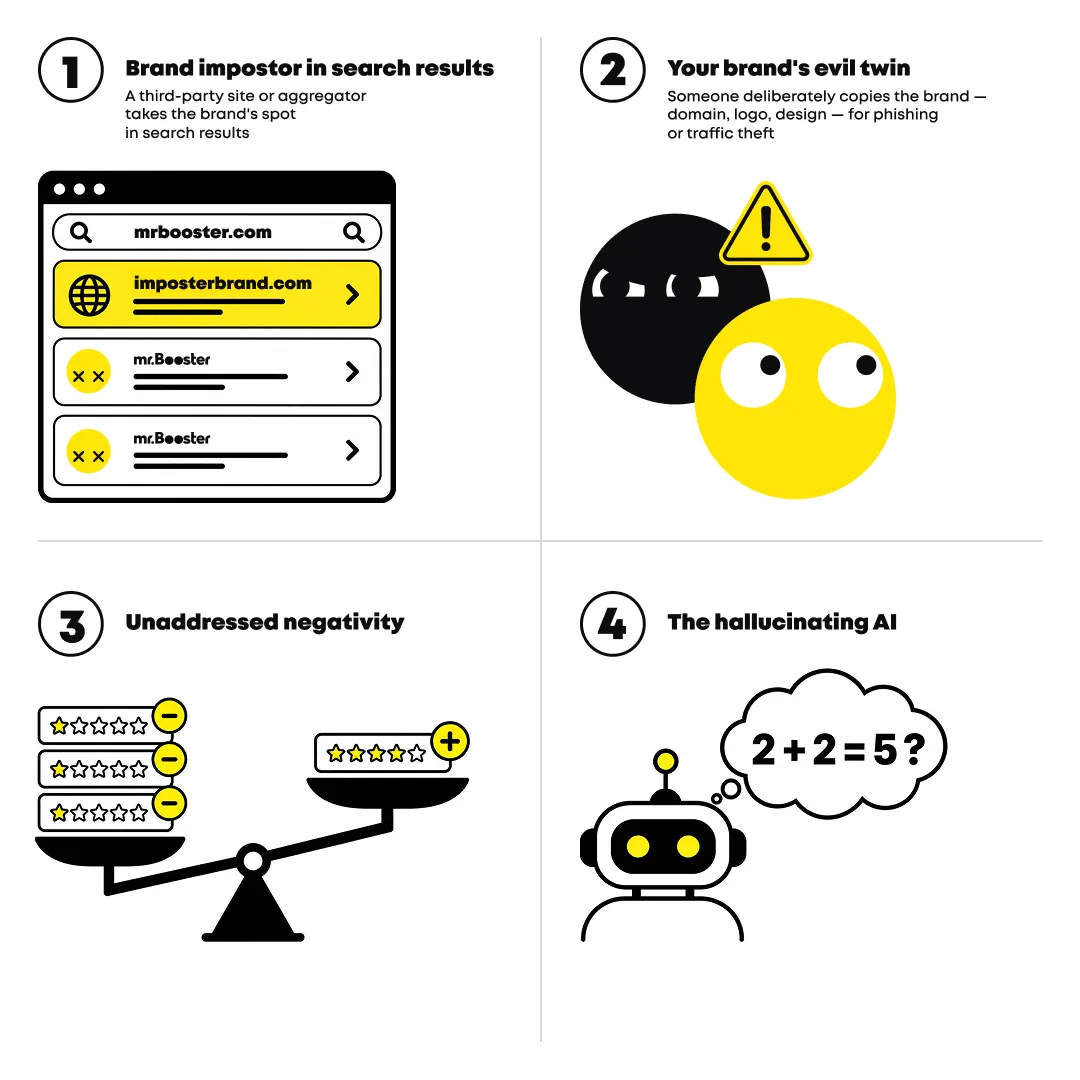
A Brand Impostor Is Taking Over Your Search Results
Let’s say you type your brand name into Google, but the top results aren’t your official website, but rather a dozen sites that have nothing to do with you: a review aggregator, an affiliate site, or even worse, a competitor.
So how does an LLM work in this case? LLMs generate responses based on their own logic and rarely rely on Google’s search results. However, this doesn’t mean the problem of competitors using irrelevant links doesn’t exist. On the contrary, it’s even more pronounced for generative engines, since many of them place greater trust in platforms with reviews and user opinions, such as Reddit.
The mere presence of other sites in search results or AI responses isn’t the end of the world. Reviews and third-party opinions actually work in your favor. The problem arises when, instead of relevant results, your potential customer sees outdated, unreliable, or blatantly sponsored pages.
Your Brand’s Evil Twin (Brand Impersonation)
A more serious scenario: someone is deliberately copying your brand. They take a slightly different domain name, use a similar logo, and create fake social media accounts. The consequences are unpleasant: phishing, user data collection, and traffic theft. And even if your brand had nothing to do with it, users will still be left with a negative impression of the brand.
Unaddressed Negative Reviews
There’s nothing wrong with receiving negative reviews: they’re all opportunities for growth. However, this can become a problem if negative content dominates search results or AI responses—due to the high domain authority of the review site—or if there’s an active discussion in a Reddit thread. These cases must be balanced out with a large amount of neutral and positive content, otherwise the recovery process can drag on for months.
AI Hallucinations
Many brands have faced this issue with the advent of artificial intelligence in our lives. LLMs easily confuse similar companies, attribute services to companies that they do not provide, or mention outdated services and features. And they do all this with such confidence, as if everything they generate were an indisputable truth. OpenAI itself warns about this in the ChatGPT help documentation.
Obviously, a brand cannot influence how the model generates responses. But you can always minimize the risk: make sure the information available online is up-to-date, ensure a consistent description of the company across all sources, and include mentions in authoritative sources—all of which will greatly simplify the AI’s task of finding information and minimize the risk of hallucinations.
What Risks Does This Create for Businesses
Ultimately, inaccuracies in AI responses lead to one clear result: a loss of trust and money. This is true both for businesses and for users who might stumble upon a fake website. So what can you do to protect yourself from such a nightmare?
A Five-Step Protection Plan
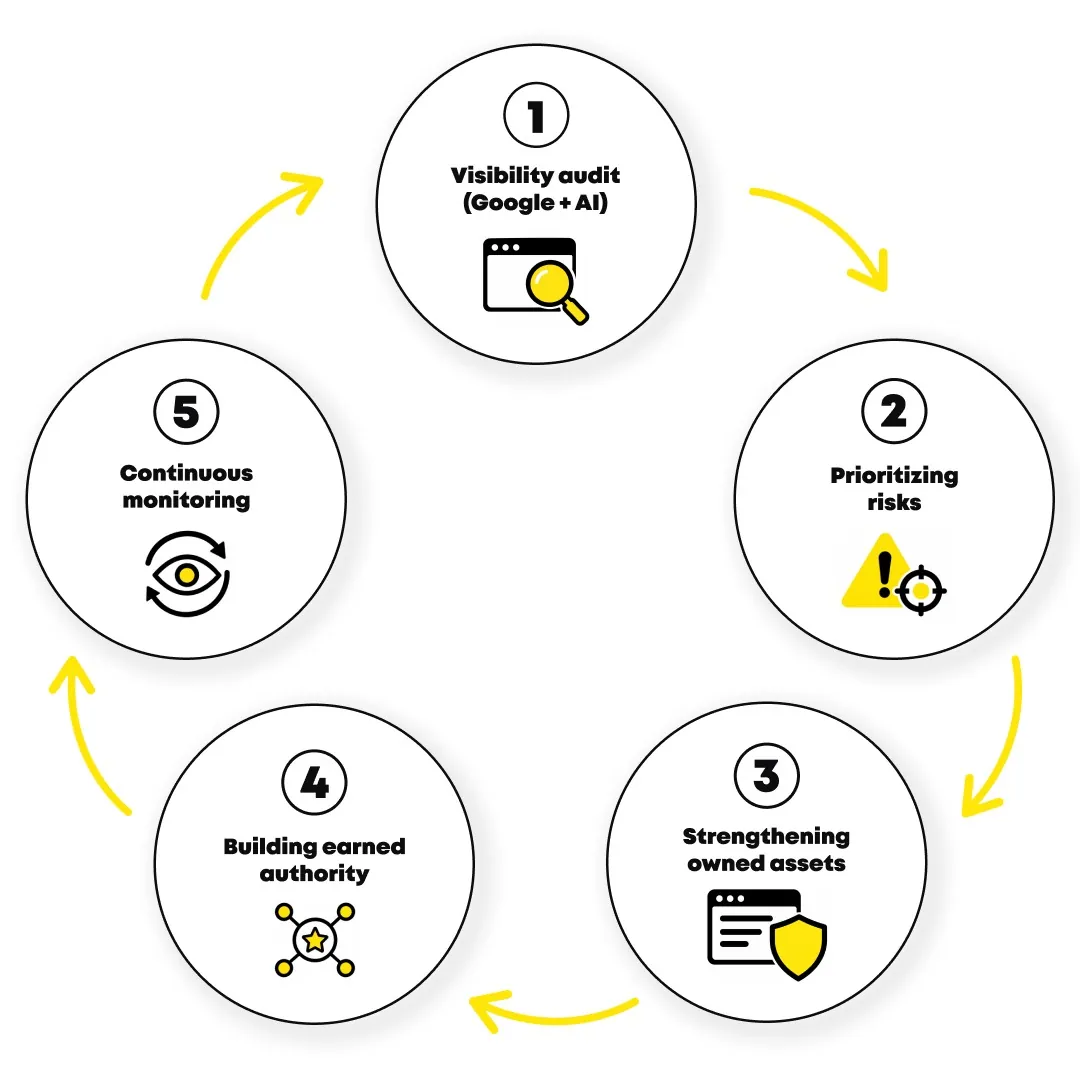
First, conduct a transparent audit. The first step is to understand the current situation. Check search queries like “[brand] reviews,” “[brand] alternatives,” and “[brand] price.” And, of course, ask the major LLMs about your brand directly and on relevant topics. This will help you find out if generative AI even notices your brand.
Next, set your priorities. It’s impossible to fix everything at once. And not every imperfect page requires an immediate makeover. But a fake website ranking at the top for a brand-related search query is more dangerous than a random negative comment on a forum with no traffic.
Boost what you can control yourself. This includes your website, structured data, internal linking, and your social media profiles. While you’re at it, check the technical side: OpenAI officially confirms that any public website can appear in ChatGPT’s search results—as long as it doesn’t block the OAI-SearchBot crawler in robots.txt. It’s a small detail, but half of all brands haven’t even thought about it.
And since we’re on the topic of controllable content, since May 27, 2026, Google has introduced the “Preferred Sources” feature, which now works not only in Top Stories but also in AI Overviews and AI Mode: users can mark the websites they trust, and these sources receive a prominent badge right within the AI response. Google claims that these sources have an average CTR that’s twice as high. This is a rare channel where audience loyalty directly translates into additional visibility in AI—and many brands haven’t even heard of it yet.
Build your external credibility. Check for expert commentary, research, and mentions in industry publications. Even without a link, such an unlinked mention serves as an independent signal of trust for both search engines and LLMs.
Don’t stop at a one-time check. Monitor more than just rankings and mentions. Pay attention to how LLMs describe you: do they accurately describe your products or services? Which competitors do they compare you to? Which sources do they cite? Because LLMs are constantly evolving and improving, their responses can change much faster than search engine algorithms.
So how can you tell if everything is working right?
Let’s circle back to the questions from the beginning of the article. If you ask an AI model about your brand, what will it say, and how accurate will that answer be?
There’s something very important that wasn’t covered by those questions, but it plays a key role in the success of a good SEO strategy. And the question is: Can all of this be measured?
It turns out, yes, it can—in three areas at once.
Number one: Traditional SEO Metrics
Rankings for brand-related search queries, the share of the first page occupied by official and trusted sources (SERP ownership), organic brand traffic, CTR, and visibility of negative mentions.
Number two: Brand Authority Indicators
The volume and quality of mentions, and the consistency of information across different platforms. In many cases, the quality of mentions is more important than the quantity: a single mention in an industry publication carries more weight than a dozen low-quality websites.
Number three: AI Visibility Metrics
- Brand mention rate — does the LLM mention the brand at all in response to relevant prompts?
- Recommendation rate — does the LLM recommend the brand or simply mention it?
- Citation frequency — how often does the AI cite the brand’s website or trusted sources?
- Competitor share of voice — who is the brand most often mentioned alongside, and are they actual competitors?
- Accuracy & sentiment — how accurately the brand is described and in what tone.
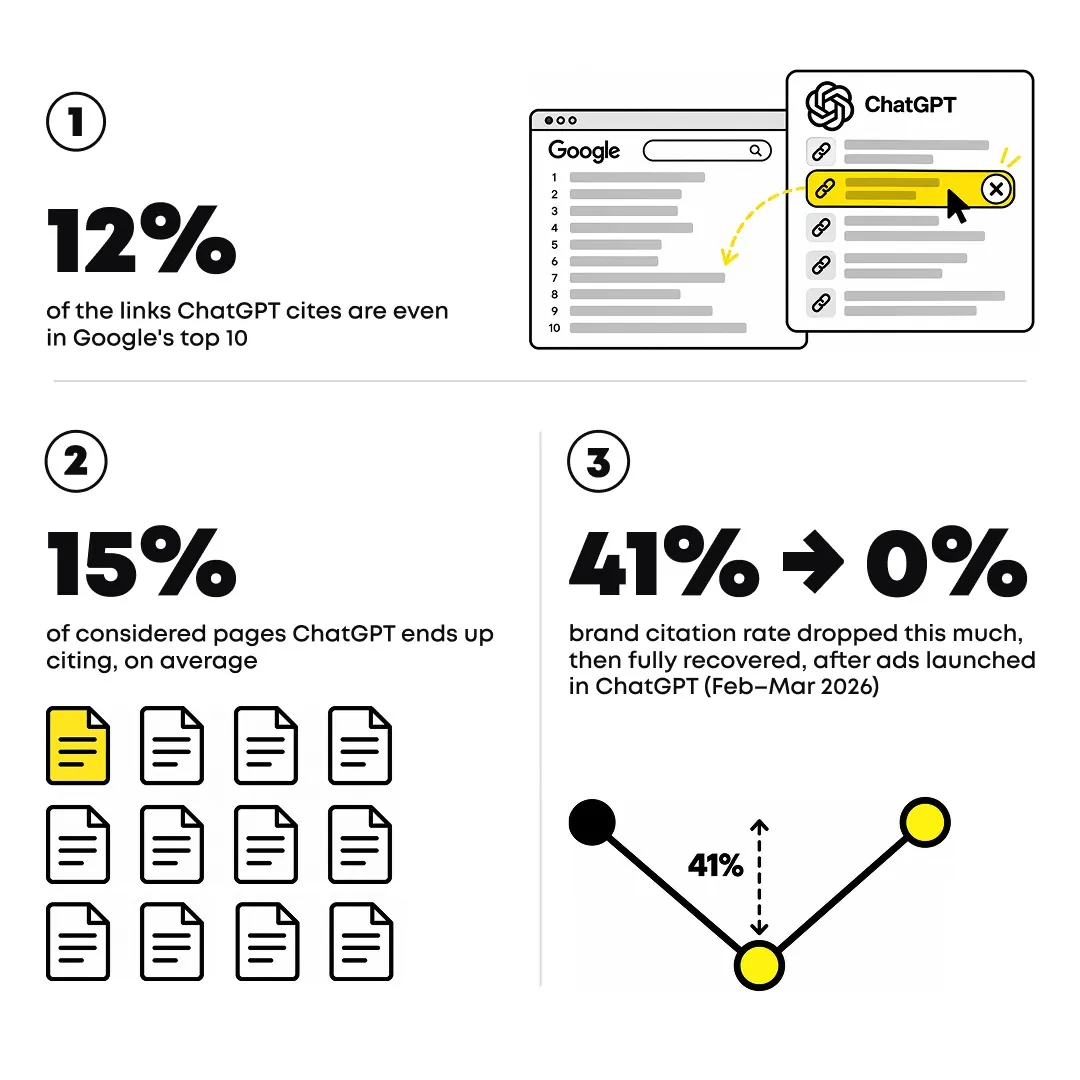
Keep in mind that only about 12% of the links cited by ChatGPT actually appear in Google’s top 10 results—a ranking in organic search results is a poor predictor of whether the LLM will cite you. At the same time, ChatGPT cites, on average, about 15% of the pages it considers when generating a response. Selection is based on content structure: clear headings and a direct answer in the first few paragraphs (it seems this article didn’t pass that filter—don’t follow our example).
Don’t forget that in the world of artificial intelligence, everything changes at lightning speed. For example, the launch of ads within ChatGPT in February 2026 temporarily caused a 41% drop in brand citations for brand-related queries, although by March the metrics had almost fully recovered. All in all, it’s worth keeping a close eye on LLMs.
💡One more important point: AI responses are inconsistent. The same prompt can generate different results when entered again. So, you should base your conclusions on a consistent set of prompts that has been tested multiple times over the course of several weeks, rather than on a single test.
Search Queries < Conversational Search
Ever since the appearance of voice assistants, there has been a noticeable trend toward search queries becoming more like a dialogue with the internet rather than a specific query entered into a search bar. Whereas users used to type “buy Adidas sneakers,” today they’re more likely to ask an LLM or type something like “which sneakers are best for long-distance running and why?” directly into the search bar.
Instead of entering a set of keywords, users describe their needs and receive personalized recommendations, and sometimes this happens even before they know the brand name. That’s why it’s so important for your SEO strategy to ensure that search engines and AI clearly understand what your company does, where it operates, and why it’s relevant to a specific request.
Moreover, brand protection now involves not only monitoring the first page of Google but also constantly monitoring how the brand is represented across the entire ecosystem of AI tools.
So, how’s your brand doing in ChatGPT?
We don’t know 😊
Try out an AI model and ask it relevant questions about your industry, review the answers, and draw your own conclusions. And whether the answers are far from perfect—or even if you’re completely satisfied with them and want to keep things that way—feel free to contact us.
The best way to boost your brand’s protection is to work with professionals who’ve done this many times before.