Let’s start by looking at the title of the article and agree not to confuse the DarkNet with Dark Social—they have nothing to do with each other (though who knows what might be lurking in your chats with close friends).
So, the term itself was coined back in 2012 by journalist Alexis Madrigal. In his widely discussed article for The Atlantic, he described a strange anomaly: a large number of readers were suddenly arriving at the site via “direct traffic”—as if they were manually typing long, impossible-to-remember links directly into the address bar.
He thought about it for a moment, dug into Chartbeat’s analytics, and quickly solved the mystery. People were simply sharing links to articles with each other in private messages or via email. These channels completely eliminate any possibility of tracking the referral path to the site before the initial data even reaches Google Analytics. He dubbed this “invisible” sharing “Dark Social.”
Now, about that 84% figure.
Why 84%? What does that 84% mean? Who makes up that 84%? And most importantly: where is that 84%?
The 84% figure first appeared in a 2016 report by the advertising and technology company RadiumOne. It was based on an analysis of the behavior of approximately 940 million users on its platform. Specifically, it concerned the share of outbound reposts: RadiumOne tracked how people technically shared links—either via visible share buttons on public platforms or by copying URLs into messaging apps, emails, and private messages. It turns out that this second, “hidden” category accounted for 84% of all recorded reposts. They had been tracking this metric for several years, and two years prior to the main report, the figure was 59%, so the share of this type of sharing had been growing steadily. .
| ⚠️Important note: Although many articles on this topic cite the figure of 84%, this data comes from a single vendor, so we’ll discuss later in this article to what extent it holds true for the rest of the industry. |
Is 84% still accurate? A more detailed analysis suggests it is — and perhaps the situation is even worse
More recently, in 2023, research company SparkToro conducted an experiment with a far more rigorous methodology than RadiumOne’s self-reported data . With the help of analyst Steve Lamar, they deliberately generated 1,100 clicks from 11 major social media platforms and tracked how Google Analytics classified each one. They tested not only sharing via private messages but also public posts, comments, links in profiles, and so on—a total of 16 different ways to share a link.
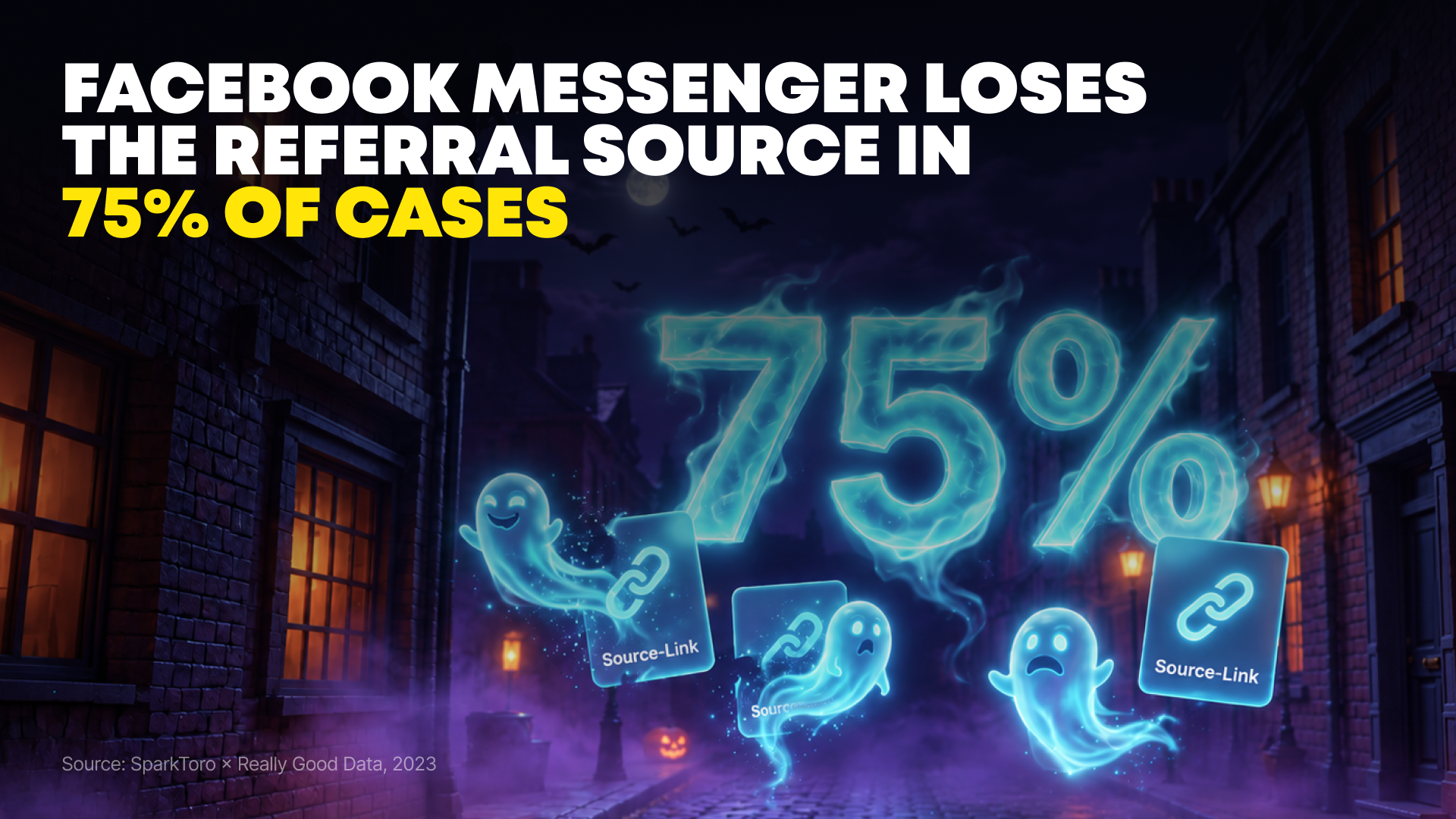
The results showed that absolutely all referrals from TikTok, Slack, Discord, Mastodon, and WhatsApp were recorded as “direct,” with no indication of the source whatsoever. Facebook Messenger “lost” referral data in 75% of cases. Even public posts on Instagram, LinkedIn, and Pinterest sometimes lost their attribution.
Looking at a broader, more controlled study, the 84% figure seems quite realistic—and therefore even more intriguing. This is truly a massive volume of traffic that marketers either overlook or mistake for a different type of traffic.
If we look at a more recent 2025 GWI study of internet users in the UK and the US, we can see that users are more likely to choose private channels for sharing (63% versus 54%), and roughly one in five users shares content exclusively through private channels, the most popular of which are WhatsApp and Facebook Messenger.
How much does it cost to ignore this data?
In 2023, 110 brands, retailers, and agencies were surveyed, and the results showed that only 3% of them were confident they can accurately measure the revenue they generated through social media. According to their own estimates, brands can only account for 44% of the actual revenue their social channels generate.
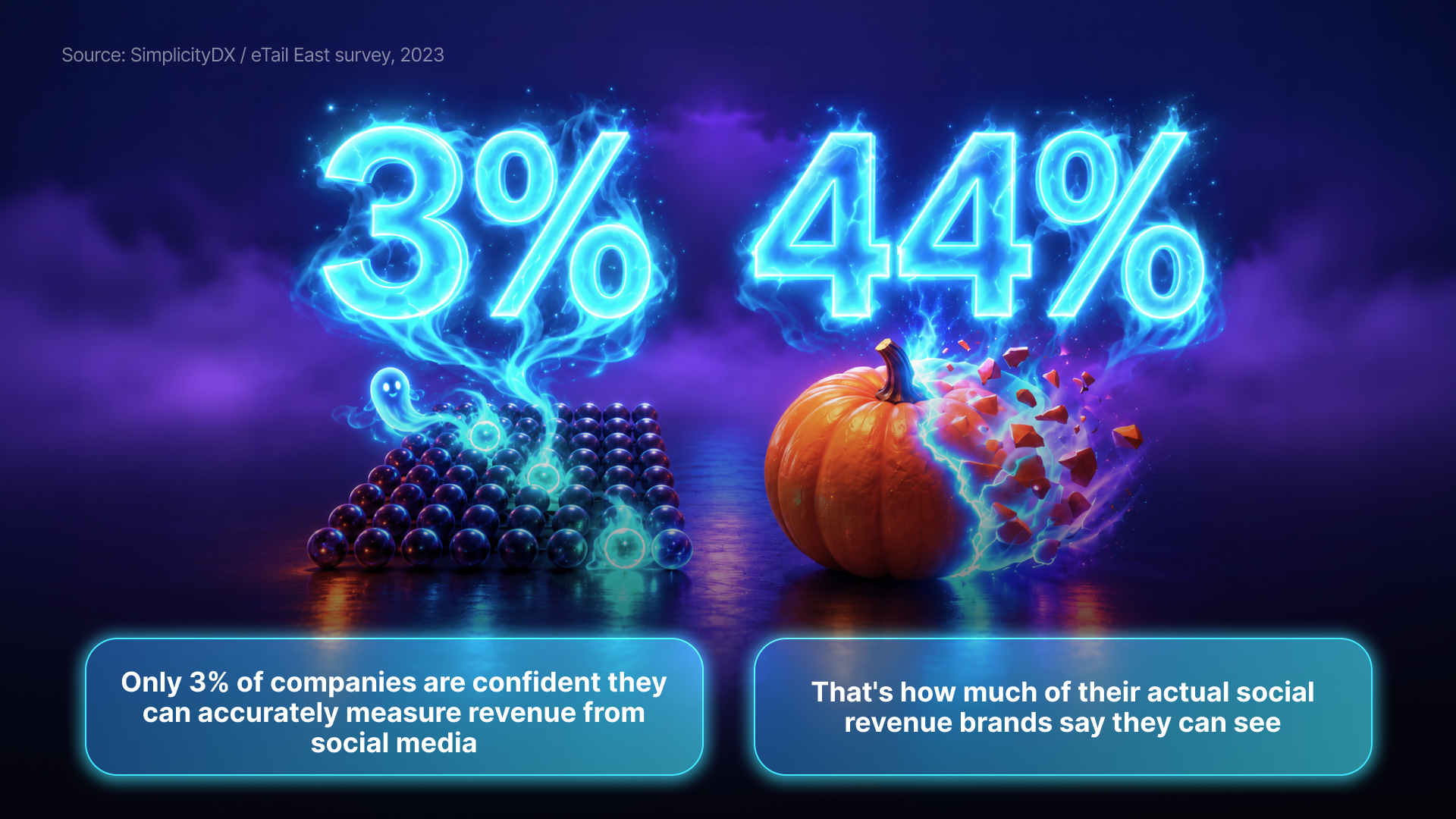
Thus, budgets are directed toward platforms where everything is beautifully highlighted and neatly arranged, like a well-lit store window. The original report from RadiumOne also indicated that 90% of the marketing budget went to public platforms like Facebook and Twitter, even though 84% of content sharing was concentrated on private channels.
The question is, does this imbalance still exist today? Most likely, the answer will vary from brand to brand.
Brands that decided to take a closer look after all
The most frequently cited case study on this topic is the BuzzFeed case. Back in 2014, the website added a “Share on WhatsApp” button to its mobile version. This was an extremely unusual move, since WhatsApp wasn’t generally considered a sharing platform. The Nieman Journalism Lab reports that this button almost immediately began to receive more clicks than the neighboring Twitter button.
Something similar happened with the sports website For The Win (USA Today): in a breakdown of shares by button, WhatsApp accounted for 18% of clicks, surpassing Twitter’s 13%, although both buttons trailed behind email (35%) and Facebook (34%).
At the time, neither BuzzFeed nor USA Today could see the full picture, since the buttons only provided data on the number of clicks they received, but not on where those clicks led. However, even the click counts alone were enough to realize that the channel was important and that “Dark Social” warranted a closer look.
Since then, the opportunities and channels for “shadow” sharing have only multiplied. Users are increasingly moving away from public feeds to a wide variety of private spaces: Slack and Discord communities, private subreddits, and closed Telegram channels. The logic remains the same as it was a decade ago with WhatsApp. That’s why you can see “Share on Telegram” buttons almost everywhere—and if your website doesn’t have one yet… it’s time to catch up with the traffic that’s slipping away.
How brands are trying to highlight this part of the funnel today
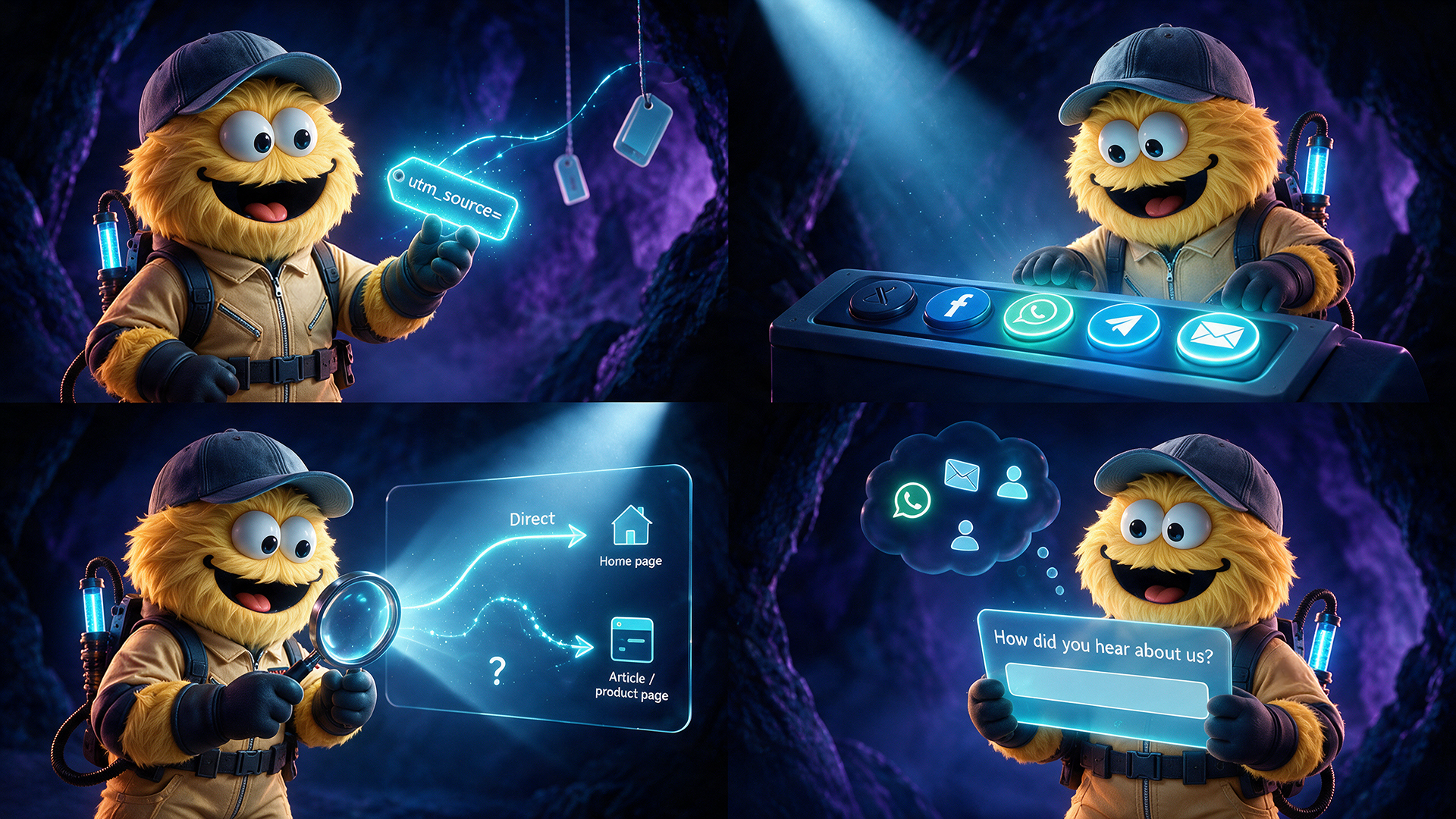
No researcher, no matter how daring, can find their way in a dark cave without a light source. Unfortunately, there aren’t that many of these “flashlights” for Dark Social, and none of them can illuminate the full picture of what’s happening in terms of sharing. Still, let’s turn to our marketer’s research backpack and pull out a couple of flashlights:
🔦Short branded links with UTM tags (via Bitly, Rebrandly, or your own link shortener)—these are created for anything that might potentially be shared in private channels. In newsletters, PDFs, and on share buttons, so that even a link copied manually carries at least some attribution and is minimally trackable.
🔦Sharing buttons for channels like WhatsApp, Messenger, Telegram, and email, placed alongside the familiar Twitter and Facebook icons. This helps simplify sharing for users and track clicks in real time.
🔦Segmenting “direct” traffic in analytics — distinguishing visits to the homepage (a link you can actually type in manually) from visits to a specific blog post or product page (few people would type in that URL from memory, and even if they did, why would they? It was more likely a private referral).
🔦Ask the user directly: include the “How did you hear about us?” field in the registration form or during checkout. Some note that this reveals useful patterns that are difficult to detect with analytics tools.
What’s the point of all this?
As you’ve been reading all this, you’ve probably asked yourself: “This is all very interesting, but why does it matter? Basically, a person received a link in a private message, clicked on it, and made a purchase—and from the brand’s perspective, nothing bad seems to have happened: neither the user nor the revenue was lost. The only thing that remains unknown is the reason for the visit.”
That’s true—the loss of attribution itself doesn’t hurt anyone. Problems can arise because of the data and its impact on various aspects of marketing, especially the budget.
Here’s a simple example: A brand launches a paid ad campaign and publishes a blog post at the same time. The post is so good that users start sharing it with each other via direct messages. People who click the link in the post appear in the analytics under “Direct,” and the source remains unknown. Formally, it looks as though the blog post “didn’t work,” whereas the ad has a clear channel label and “shows results.” Consequently, the budget gets prioritized for advertising, without accounting for the success and value of organic traffic.
So it turns out that incomplete attribution isn’t a problem in and of itself, but it distorts the picture of the effectiveness of different channels and content. At the same time, budget decisions are made based on this distorted picture. That very gap RadiumOne wrote about—84% of sharing in private channels versus 90% of the budget in public channels—is not a funny coincidence, but a direct consequence of decisions being made based on incomplete data.
What SEO Experts Say
Of course, Dark Social also affects SEO metrics. That’s why we asked our SEO experts whether they take it into account in their work and what they generally think about the mysterious “direct visits” to pages that may be part of Dark Social.
“Direct traffic in analytics is also a pain in the neck for SEO teams,” says Anastasiia Popova, Head of SEO. “It shouldn’t be viewed solely as traffic from users who manually typed in the website address.”
For SEO, this is especially important from an attribution standpoint: a user finds a site through organic search and then shares it with another user. The second visit will be recorded as direct, even though it was actually organic. Often, a portion of SEO traffic is attributed to direct traffic.
Unfortunately, it’s practically impossible to completely separate Dark Social from the overall direct traffic. At the same time, it’s also incorrect to classify all direct traffic as Dark Social—there are simply too many different scenarios mixed in. Therefore, for us, this serves as a reminder that analytics data doesn’t provide the full picture, and SEO effectiveness cannot be assessed solely based on the last recorded referral source.
We know that SEO can be difficult and exhausting. And that sometimes we wish everything were simpler and easier to understand. But the easiest path isn’t always the best one. Read more about this in the article “How to Survive Without Blackhat SEO Techniques in 2027?”
Honest conclusion
Dark Social is a phenomenon that will continue to haunt marketers’ minds for as long as the internet exists. Due to the very nature of private messages, the only thing we can count on without violating anyone’s privacy is the shadows on a cave wall—and we’ll be lucky if we can make out any data at all from those shadows. However, this doesn’t mean we shouldn’t focus on Dark Social. On the contrary, it remains one of the key channels with a massive amount of traffic that needs to be captured and accounted for in analytics as much as possible.
Success won’t mean perfect measurement. It’s enough to make sharing convenient for users, even if that means analytics will only receive partial signals. After all, partial signals are better than no signals at all.
The invisible part of the funnel will work whether you account for it or not, but it’s still better to account for it.